The Anti-Algorithm Revolution: Emerging Movements of Algorithmic Refusal and the Philosophy of Coordinated Withdrawal
How No Kings and other decentralized movements are building the infrastructure of refusal—and what you can do to join them.

“My heart is moved by all I cannot save:
so much has been destroyed
I have to cast my lot with those
who age after age, perversely,
with no extraordinary power,
reconstitute the world.”
— Adrienne Rich, “Natural Resources” (1978)
The refusal is already happening (you just haven’t been shown it)
But you have already felt it, haven’t you? That uncanny sensation of the social media feed not just reflecting our reality but actively generating it—a predictive text controlling our own becoming. The subtle psychic pressure to perform a self that is legible to the platform, to feel an emotion that will register as engagement, to think a thought that is already a trending topic. This is the new enclosure, not of common lands, but of attention itself. Not property, but perception.
And yet, the refusal is already happening.
Every Sunday afternoon, a band of teenagers gathers on the steps of Brooklyn’s Central Library at Grand Army Plaza—seventeen-year-old Logan Lane with a flip phone in her pocket and a book for the subway, Jameson Butler wearing a hand-sewn Luddite patch on her vest, Biruk Watling carrying a guitar and a journal, Odille Zexter with watercolors and sketch pads. They are the founding members of the Luddite Club, named not for technophobia but for the nineteenth-century “Luddites“ textile workers who refused the machines that were stealing their livelihoods and their lives.
Lane was fourteen when the pandemic hit, and her screen time exploded to eight hours a day. “I could feel my brain chemistry changing,” she would later say. “I was so bored without my phone, but I was also so alive.” She deleted Instagram, Snapchat, and TikTok. She traded her iPhone for a flip phone. She met Butler at a party—two teenagers who bonded over the radical act of not having a smartphone. They started meeting every week. The club was born.
What do they do on those library steps, in that tucked-away corner of Prospect Park they’ve claimed as their territory? They read—Kurt Vonnegut, Don DeLillo’s White Noise, A Quaker Book of Wisdom, and Krakauer’s Into the Wild. They play guitar and sing. They journal, sketch, and watercolor. One member, Max Frackman, brings a hammock and whittles sticks. They practice the nearly-forgotten art of being bored together, of sitting in silence without reaching for a screen, of making art that will never be posted, of having conversations that leave no data trail.
The club started with seven members at Edward R. Murrow High School. Now there are sixteen. It has spread to Brooklyn Tech, Beacon High School, Temple University in Philadelphia, and Telluride, Colorado. A former teacher named Amanda Hanna-McLeer quit her job to make a documentary about them. The New York Times profiled them. NYC declared social media a public health hazard in 2024, partly because of what these teenagers made visible: that the refusal is possible.
In a surveillance economy, illegibility is power.
But here is where the story gets complicated, where the prophetic vision blurs into the real. After the initial surge of attention, most people scrolled past. When Butler and other members set up a table at Brooklyn Tech to recruit new members—posting signs that read “Are you addicted to your phone? Do you like to have fun?”—students walked by without even looking up from their screens. “Right now we’re just in need of a wellness revolution against technology,” Butler told a reporter, exhaustion creeping into her voice.
The movement grows, yes. But slowly. Unevenly. Lane is now at Oberlin College, still carrying her flip phone, still giving talks about her “Luddite Manifesto.” Butler is spreading the word at Temple. Watling is recruiting in Colorado. They are holding the line. But the line is thin, and the algorithm is everywhere.
Even this essay about their refusal will find its way to you through the machine. That is not hypocrisy—it is the condition we are all trapped in. We are caught in this loop, this bind where the critique is absorbed, the rebellion is monetized, and even refusal becomes content. The Luddite Club knows this. They meet anyway. They read, sing, and journal anyway. They snap their flip phones shut with satisfaction and walk into Prospect Park, anyway—because they have learned what Foucault knew: visibility is a trap.
The refusal is already happening. You just haven’t been shown it—or you scrolled past it without noticing.
Tactics of the Ungovernable
If the grand exodus falters—if even our dissent becomes fuel for the machine—then refusal must become something other than escape. We cannot build a better platform; the logic of the old world travels with the settlers. Instead, we must learn the tactics of the parasite, the algorithm, the capitalist. We must map the territories of withdrawal already emerging—not as alternatives, but as strategies for dealing with the machine from within.
Consider Everest Pipkin, a 32-year-old artist and game designer based in Texas, whose practice involves systematically corrupting digital files—images, documents, the raw material of the archive. In their 2019 project The Library of Nonexistent Books, Pipkin downloaded thousands of texts from Project Gutenberg and subjected them to ‘lossy compression’ cycles, repeatedly saving and re-saving until the files became beautifully broken, unreadable ghosts of their former selves. ‘I want to make things that resist being datafied,’ Pipkin told an interviewer. ‘If everything becomes readable to machines, then everything becomes exploitable.’
This is not mere aesthetic play—it’s a recognition that in a surveillance economy, illegibility is power. When an algorithm cannot parse your work, it cannot be sold, cannot be optimized, and cannot be fed into a training dataset for the next AI model. Pipkin joins a constellation of glitch artists—Rosa Menkman’s ‘vernacular of file formats,’ the tactical media interventions of Mediengruppe Bitnik—who understand that sometimes the most political act is to refuse to make sense. You may have my file, they say, but you cannot have its soul. Hacking as an artistic strategy.
The sabotage takes other forms. In encrypted Signal groups across the country, organizers are building what they call ‘digital sanctuaries’—temporary autonomous zones where tactical planning happens outside the surveillance economy. When tenant organizers in Los Angeles coordinate rent strikes, they do it in Signal channels with disappearing messages. When mutual aid networks in Detroit distribute resources during crises, they use encrypted spreadsheets shared peer-to-peer, no cloud storage, no corporate intermediary.
This is the digital samizdat, the modern equivalent of Soviet dissidents passing mimeographed manuscripts hand to hand. But there’s a tension here: Signal still requires smartphones, still runs on corporate infrastructure, still concentrates power in a single nonprofit foundation. Groups get infiltrated. Metadata can be subpoenaed. The sanctuary is never absolute.
And yet—for labor organizers facing employer retaliation, for undocumented immigrants coordinating mutual aid, for protesters evading police surveillance—these encrypted spaces offer a breathing room—a place to plan the next action without feeding your strategy to the algorithm in real time. The refusal here is not permanent withdrawal but tactical invisibility: you cannot monitor what you cannot see.
But the most profound withdrawal operates at a different level entirely, questioning not just how we use data but what data is. Consider the work of the Māori Data Sovereignty Network in Aotearoa (New Zealand), which developed the concept of kaitiakitanga—guardianship—as an alternative to ownership. When government agencies collect health data on Māori communities, the Network asks: Who benefits from this knowledge? Who is harmed? What are our responsibilities to the ancestors whose stories inform this data, and to the descendants who will inherit its consequences?
Or look to Native Land Digital, a Canadian Indigenous-led project mapping traditional territories and treaty boundaries. Unlike Google Maps, which treats land as neutral coordinate space, Native Land’s interface asks users to acknowledge whose territory they’re on, embedding relationality into the very act of looking at a map. The data isn’t extracted—it’s offered, on Indigenous terms, with protocols for its use.
This is not a demand for inclusion in the existing system. It’s a rejection of the entire colonial-capitalist ontology. As Tahu Kukutai and John Taylor write in Indigenous Data Sovereignty, the question shifts from ‘How can we own our data?’ to ‘What are our responsibilities to the stories and the people this data represents?’ Data becomes not a commodity but a relative—something you have obligations toward, not just rights over.
These projects face enormous challenges, though. They must navigate settler legal systems that don’t recognize Indigenous sovereignty. They must use Western technologies—databases, the internet itself—to protect knowledge that predates and exceeds those technologies. Internal debates rage about which knowledge should be digital at all, which must remain oral, and which must be kept within ceremony. But the withdrawal here is categorical: a refusal to play by rules written to erase you.
“Opacity is not the opposite of transparency; it is the right to not be understood on command.”
— Édouard Glissant, Poetics of Relation (1990):
These movements—the glitch artists corrupting files, the organizers encrypting their channels, the Indigenous nations reclaiming their data—are not building a new world. They are learning to haunt the old one. They are not blueprints for utopia but tactics of fugitivity, intentional acts of strategic decomposition, ways of making the machine choke on what it tries to consume.
The question is not whether they will ‘win’—the system is too large, too adaptive, too hungry for that framework to make sense. The question is whether their refusals can create enough friction, enough noise, enough ungovernable space, that other ways of being become possible. The withdrawal is already underway. Now we must learn to read its methods.
Anatomy of a Decentralized Refusal
Every tactic of refusal carries its own betrayal. The system, it turns out, follows you everywhere—not because it’s omnipotent, but because its logic is relational. It’s not a thing you can escape; it’s a pattern you reproduce.
Consider Bluesky, the decentralized platform that was supposed to solve Twitter’s authoritarian turn. Jack Dorsey funded it in 2021 as a Twitter initiative, envisioning an open protocol where no single company could control the town square. By 2022, after Musk’s takeover, Bluesky spun off as an independent public benefit corporation, and early adopters flooded in—over 3 million users by late 2023.
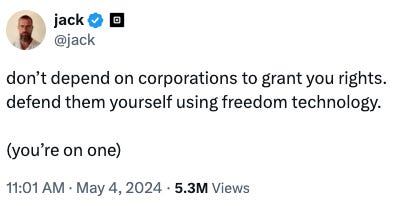
But then came the Series A: $15 million from Blockchain Capital in October 2023. Suddenly, a ‘public benefit corporation’ had venture capital investors expecting returns. Dorsey himself grew disillusioned. In May 2024, he resigned from Bluesky’s board, posting cryptically: ‘Don’t depend on corporations to grant you rights. Defend them yourself using freedom technology.’ Translation: even the decentralized alternative was being captured.
The problem isn’t just funding—it’s protocol design. Bluesky runs on the AT Protocol, which technically allows anyone to build a client or server. But in practice? As of October 2025, over 95% of users are on the official Bluesky app, hosted on Bluesky’s servers. Federation in theory, centralization in practice. One developer told me: ‘It’s like if email existed but everyone still used Gmail because nothing else worked as well.’
And the competition isn’t helping. Mastodon runs on ActivityPub, celebrated as ‘the best available standard’ for federation—but as insiders quietly admit, it’s best because it’s the only standard with adoption—no one’s building alternatives because the network effects are already entrenched. We’ve traded one monopoly (Twitter) for a fragmented oligopoly (Bluesky, Mastodon, Threads all using incompatible protocols), where the fantasy of true decentralization masks the reality of new gatekeepers.
“Wrong life cannot be lived rightly.”
— Theodor Adorno, Minima Moralia (1951)
The same poison infects our encrypted sanctuaries. In 2020, Black Lives Matter organizers in Portland used Signal to coordinate mutual aid and evade police surveillance. In 2021, Proud Boys used Signal to plan their January 6th attack on the Capitol. Same tool. Same encryption. Different world-building.
Human rights organizations in Hong Kong use Signal to organize protests under the National Security Law. White nationalist groups in the U.S. use it to coordinate harassment campaigns. Kurdish activists in Turkey use it to document state violence. Far-right militants in Brazil used it to plan the January 8, 2023, storming of government buildings.
The tool is perfectly agnostic. When U.S. senators demanded Signal create backdoors for law enforcement in 2023, civil liberties groups defended the platform—knowing full well that the same encryption protecting whistleblowers also protects terrorists. There is no technological solution to this moral paradox. Encryption doesn’t care about your politics. Nor does technology or AI in general.
And this creates a deeper problem: the withdrawal into communicative darkness doesn’t build solidarity—it fragments resistance into disconnected cells. A thousand encrypted channels, each invisible to the others, each organizing separately, unable to coordinate at scale. The neo-fascists figured this out before we did: they built bridges between their channels, created networks of networks, turned tactical opacity into strategic coordination. Meanwhile, the left remains atomized, each Signal group protecting its own small circle, suspicious of federation, terrified of infiltration.
The darkness that protects you also isolates you. And isolation, as every organizer knows, is how movements die.
“What matters is not technology itself, but the social or economic system in which it is embedded.”
— Langdon Winner, “Do Artifacts Have Politics?” (1980)
The machine we’re trying to jam is not a technological apparatus—it’s a social and economic relation, and its logic is far more adaptive than any protocol.
When users fled Facebook for privacy-focused alternatives, Meta bought WhatsApp (2014, $19 billion) and Instagram (2012, $1 billion). When Mastodon gained traction post-Musk, Meta launched Threads (2023) with built-in ActivityPub integration—colonizing the ‘decentralized’ protocol with 100 million users overnight, more than all Mastodon instances combined. When ad-blocking threatened revenue, platforms pivoted to ‘creator economy’ models, turning users into unpaid content generators. When privacy regulations (GDPR, CCPA) threatened data collection, platforms just... paid the fines as a cost of doing business.
The system doesn’t fight alternatives—it absorbs them. Decentralization becomes a selling point. Privacy becomes a premium feature. Resistance becomes a brand. Every genuinely threatening innovation either gets acquired, copied at scale, or regulated out of existence. Technology is part of the problem. But we depend on technology to get organized to fight it.
And the logic extends beyond platforms. When workers organize in encrypted channels, capital responds with surveillance software that doesn’t need to crack encryption—it just monitors productivity, tracks mouse movements, and takes screenshots at random intervals. When artists try to poison AI training datasets with tools like Nightshade and Glaze, AI companies respond by training on synthetic data, cutting out human creators entirely. When communities build local mesh networks to bypass ISPs, telecom companies lobby for laws making community broadband illegal.
The withdrawal is not enough. The refusal is not enough. The system is not a fortress to be avoided—it’s a weather pattern, and we sail to its winds.
If decentralization fails, encryption fragments us, and capitalism absorbs all alternatives—what then is the actual problem?
The contradictions inherent in our escape reveal the true nature of the techno-capitalistic prison. We have been fighting the guards when we should have been studying the architecture. The failure of our tactics points to a fundamental misdiagnosis of the problem. This is not about technology; it is about the algorithmic logic of power that technology now serves.
Shoshana Zuboff gave this ghost a name: surveillance capitalism. Not capitalism with better ads, but a ‘distinct logic of accumulation’ that discovered the most abundant resource on Earth: our own lives, our attention, our intimacy.
In 2014, Facebook experimented on 689,000 users without their knowledge. Researchers manipulated news feeds to show more positive or negative content, then measured whether users’ own posts became more positive or negative. It worked. They could induce emotional states remotely. They published the results in a scientific journal. The outcry was brief. The practice continued.
This is behavioral surplus extraction. Your clicks, pauses, hesitations—the ‘data exhaust’ of simply existing online—become raw material. Facebook didn’t just show you the experiment results; they sold what they learned. Insurance companies buy intent data to predict who’ll file claims. Political campaigns buy psychographic profiles to target swing voters. Employers buy personality assessments scraped from your LinkedIn activity. There is now a real-time bidding market where your attention is auctioned 294 billion times per day—faster than high-frequency stock trading.
We are not the customer, not even the product. We are the abandoned carcass from which a new form of value has been stripped. And the value isn’t just in selling us things—it’s in modifying our behavior at scale, predicting and shaping what we’ll do next, turning the future itself into a commodity to be bought and sold.
I don’t think I can be any clearer about what’s happening. Let me say it again: “behavior modification at scale, at the will of those who control technology”.
To make it worse, this parasitic logic doesn’t colonize virgin territory. It operates on a landscape already scarred by centuries of oppression. Safiya Noble showed us how algorithms automate and scale historical violence. Her research began with a simple search: ‘Black girls.’ Google returned pages of pornographic and hypersexualized results—not a glitch, but a feature. The algorithm had learned from the internet’s existing racism, amplified it through billions of queries, and presented it as objective truth. When Noble published her findings in 2012, Google quietly adjusted the specific query. The system remained unchanged. Because here’s what Noble revealed: search results aren’t neutral information retrieval—they’re advertising inventory. Companies bid on keywords. ‘Black girls’ was cheap to buy because respectable advertisers avoided it. Porn sites bid high. The algorithm served what was profitable, not what was true. Racism was on sale.
And it scales. Facial recognition software has an error rate of 34% for dark-skinned women, compared with 0.8% for white men (MIT 2018 study). Not because the technology is inherently flawed, but because training datasets reflect existing power structures—mostly white faces, mostly men. When that software is deployed by police departments, landlords, and employers, the bias becomes automated discrimination with a technical alibi.
The algorithm is just a landlord with a better eviction notice. It doesn’t need to say ‘no Black applicants’—it just predicts ‘high risk’ and moves on. The machine learns our racism, launders it through code, and sells it back to us as reality.
“And if all others accepted the lie which the Party imposed—if all records told the same tale—then the lie passed into history and became truth. ‘Who controls the past’ ran the Party slogan, ‘controls the future: who controls the present controls the past.’”
— George Orwell, 1984
And here we arrive at the political climax of this dispossession [of our shared reality]. The ultimate goal isn’t just profit—it’s the dismantling of a common world. We no longer speak the same language because we no longer see the same world, and without a shared world, there can be no shared meaning. We cannot confirm each other’s reality. And without that—without the assurance that what I see, you see too—politics dissolves into a war of private hallucinations.
Hannah Arendt called it the ‘space of appearance’: that shared public realm where we appear before one another, in all our plurality and difference, to speak, to act, to create reality together, to enjoy each other’s vulnerabilities. This space requires a common ground—not agreement, but shared facts, shared experiences, a shared stage.
Social media is designed to destroy this space. Here is polarization in practice: During the 2020 election, researchers at NYU analyzed what Facebook showed users about voting. Conservatives saw posts claiming fraud and irregularities—shared 10 million times. Liberals saw posts about voter suppression and intimidation—shared 8 million times. Both groups saw ‘evidence’ supporting their worldview. Both groups believed the other side was lying or deluded. Neither group was shown what the other was seeing.
Algorithmic polarization scales indiscriminately. Take COVID-19. In March 2020, videos of overwhelmed Italian hospitals went viral. But Facebook’s algorithm showed them primarily to users already concerned about the pandemic. Users skeptical of lockdowns saw different content: videos of empty hospitals, claims about exaggerated death counts, and doctors questioning official numbers. By April, Pew Research found that Americans lived in two different pandemics—not just politically divided, but informationally segregated. What you saw depended on what the algorithm had already learned you wanted to see.
Who knew one of the freedoms we most needed was the freedom to assemble?
This isn’t a bug. This is how personalization works. The feed learns your preferences and shows you more of what keeps you engaged. Engagement means clicks, shares, time spent—and nothing drives engagement like outrage, fear, and confirmation of what you already believe. Ironically, we came to learn that shared reality is boring. It doesn’t keep you scrolling.
In Arendt’s terms, the feed doesn’t create competing perspectives within a shared world—it creates multiple worlds that no longer touch one another. You and your neighbor no longer disagree about what to do; you disagree about what is real. And when there’s no shared reality, there’s no possibility of politics—only the administration of atomized subjects, each trapped in a reality bubble calibrated for maximum extraction. It’s like humans saying goodbye to each other because they will never agree on what real is.
This is the demolition of the polis, one user at a time. Not through censorship or propaganda—through algorithmic slavery. Through giving each of us exactly what the algorithm has learned we want, until we can no longer see each other at all.
3 x 1 - Machine x Human
We have three forces working against us, all three autonomously: Surveillance capitalism provides the infrastructure—the machinery of extraction and behavior modification. Algorithmic oppression provides the targeting—the ability to automate discrimination, to know which buttons to push for which populations. Personalization provides the atomization—the dissolution of shared reality into digital enclosures.
The result is far from a more efficient advertising system. It’s a totalitarian system that designed most profitable product on Earth: human hatred—and it’s mining it at industrial algorithmic scale. It made every fracture in the social fabric a market opportunity. Every identity micro-targeted, Fear monetized. Every grievance amplified or suppressed depending on what drives engagement. System prompt: Angry people click more. Scared people share more. Clicking is growth. Sharing is optimized. Every community, split into warring factions. Each fed a different reality. Each believing the other is mad or malicious.
If this is not AGI I don’t know what is! This system doesn’t even need a conspiracy. There’s no cabal deciding to destroy democracy. There are just engineers optimizing for engagement, executives maximizing shareholder value, algorithms learning what keeps us clicking. The result—the demolition of shared reality, the automation of oppression, the extraction of our inner lives—is an emergent property of the system, not a planned outcome.
Which makes it more dangerous, not less. You can’t arrest an algorithm. You can’t regulate an emergent property. You can’t vote out a system that operates below the level of individual decisions, that makes us into what Zuboff calls ‘the human herd’—not through force, but through the accumulated micro-manipulations of ten thousand personalized nudges per day.
This is the architecture our new algorithmic prison, one we’ve been trying to escape. Not walls, but “weather”. Not guards, but autonomous algorithms. Not a single enemy, but a diffuse logic of power that flows through data centers, tech and private equity boardrooms, government offices, and global leaders in places like Davos. We lost the human governance of this process.
The Luddite Club meets on library steps. Artists corrupt their files. Organizers encrypt their channels. Indigenous nations reclaim their data. But the ghost in the machine isn’t in any particular machine—it’s in the relation between extraction, oppression, and atomization that these technologies now serve.
So when we ask ‘what is to be done?’, we must first understand: the problem is not the platform. The problem is the world the platform was built to serve.” In this world, our will became decoupled from our ethics. Our faith became diffuse in the fog of war.
The hard personal act of refusal is about human solidarity. A “human-first” approach is needed.
What, then, is to be done? If the architecture is the prison, the exits are haunted, and the economic logic is totalizing, are we simply left to lament our condition in a perfectly personalized echo chamber? The diagnosis is bleak, and any promise of a simple cure would be a lie, another piece of wellness snake oil sold to you in a targeted ad. The art of refusal, then, cannot be a blueprint for a new utopia; it must be a messy, contradictory, and perhaps even failing practice of building cracks in the walls of the present. We must fight fiction with fiction, story with story, truth to truth. We must reject the false choice between individual escape and collective action, recognizing them instead as two moments in a single dialectical movement. We must clear our ‘space of appearance.’
For some, it’s adopting the Luddite Club’s flip phone, accepting inconvenience as the price of attention. For others, it’s Shabbat rules adapted for the digital age: sundown Friday to sundown Saturday, all screens off, no exceptions. For still others, it’s using tools of digital asceticism—apps like Freedom or Cold Turkey that lock you out of the feed, phone lockboxes with timers, the extreme measure of leaving your smartphone at home and carrying only a basic Nokia.
While recognizing the embedding of technology throughout the withdrawal process. The gig worker can’t ignore the DoorDash notification. The parent can’t miss the school emergency text. The organizer can’t abandon Signal when ICE is raiding the neighborhood. Total logout is not an option. So the question becomes: How do you withdraw enough to think clearly while staying present enough to survive and organize?
What do we need? How do we build it together? Who’s being left out?
The easy answer will be in rituals of disconnection. Hours when the phone goes in a drawer. Designated spaces (bedrooms, dinner tables) that are screen-free zones. The practice of checking media or email at set times—9am, 1pm, 5pm. Free from a state of constant notification. Practices instead of solutions—small refusals that create breathing room.”
The hard answer is that individual withdrawals are meaningless if they remain isolated. Its purpose only emerges when turned outward, toward the slow human work of collective building. We need to re-adjust the velocity of progress to a human scale, not an algorithmic one. We need to play with time and return to the present.
We need more Zapatistas, whose organizing principles offer a counter-logic to Silicon Valley. In a world that demands ‘move fast and break things,’ they insist: caminar preguntando—’walking, we ask questions.’ Not: here’s the platform that will save us. But: what do we need? How do we build it together? Who’s being left out?
This is a different temporality entirely. Trust built at the speed of conversation, not at the speed of code deployment. Decisions made by consensus in village assemblies, not by venture capitalists in boardrooms. Infrastructure that serves communities first, scales second (if at all), and profits never.
What does this look like in practice? It looks like the Brooklyn Luddite Club, still meeting every Sunday three years later, now seeding chapters in ten cities. It looks like community fiber networks in Detroit where residents own the infrastructure collectively. It looks like the Cooperation Jackson project in Mississippi—worker cooperatives, community land trusts, and a people’s assembly making decisions about technology democratically. It looks like the Movement for Black Lives using Signal and Zoom tactically while building in-person chapters where the real organizing happens. Who knew one of the freedoms we most needed was the freedom to assemble?
It looks like librarians in rural America running Mastodon instances as a public service, the way they used to run community bulletin boards. It looks like unions negotiating for ‘right to disconnect’ clauses in contracts—your boss can’t text you at 11pm, your off-hours are legally protected. It looks like cities passing laws requiring interoperability—platforms must allow users to export their data and connect to other platforms, breaking the network effect moat.
Not knowing what will work, we need to experiment. Take a leap of faith. Some will fail. Some are already compromised. But they share a common principle: technology should serve communities, not extract from them. And they share a common practice: building slowly, durably, at human scale, answerable to those who use it rather than those who fund it.”
“Pessimism of the intellect, optimism of the will.”
— Antonio Gramsci, Prison Notebooks (1929-1935)
These aren’t solutions. They’re starting points. The exodus is not a destination; it’s a practice. The refusal is not a solution; it’s a commitment.
And it starts—if it starts at all—with the smallest, hardest thing: closing this tab and not opening another.
The algorithm is waiting. It knows exactly what you want to see next. It has already prepared your next hit of information, your next comfortable distraction.
But you don’t have to click. Not this time. Not today.
Further Reading:
Kramer, A.D.I., Guillory, J.E., & Hancock, J.T. (2014). “Experimental evidence of massive-scale emotional contagion through social networks.” Proceedings of the National Academy of Sciences.
Read the study
Facebook’s 2014 experiment manipulating 689,000 users’ feeds to test emotional contagion.Buolamwini, Joy & Gebru, Timnit (2018). “Gender Shades: Intersectional Accuracy Disparities in Commercial Gender Classification.”
Read the study
MIT study showing facial recognition error rates: 34.7% for dark-skinned women vs. 0.8% for light-skinned men.Guess, Andrew M. et al. (2023). “How do social media feed algorithms affect attitudes and behavior in an election campaign?” Science.
Read the study
NYU study showing Facebook created divergent realities during 2020 election.Vadukul, Alex (2022). “’Luddite’ Teens Don’t Want Your Likes.” The New York Times.
Read the article
Original profile of Logan Lane and the Brooklyn Luddite Club.Kukutai, Tahu & Taylor, John (eds.) (2016). Indigenous Data Sovereignty: Toward an Agenda. ANU Press.
Download free
Foundational text on Indigenous approaches to data governance.
if you’re seeing this, it’s because of an algorithm. Think about that.
This hits home. It’s disappointing when friends get together just to be on the phone. Hope things keep swinging the other way. Thanks for this piece.