The Ground Still Holds Us
Finding light in the age of algorithmic grief

“Let everything happen to you: beauty and terror. Just keep going. No feeling is final.”
— Rainer Maria Rilke
I woke up at 6 am. My mind running wild.
My cousin passed away on Sunday of a sudden heart attack, and I am still grieving.
Separately, I have distant elderly relatives sitting alone in houses their children left years ago, scattered by economic necessity to different cities. I remember spending good times with them when they were younger. I miss them.
Outside my window, birds are playing in the snow. They don’t check the feed. They don’t know what century it is.
I put on Tibetan chants - white noise for a mind that wants to spiral. Pour coffee. Try to find some silence inside the noise.
A colleague I trusted as a friend made a move today that put me in a difficult position at work. Not malice, I think. Just a small algorithmic calculation that the system teaches us to make. I wasn’t angry - just disappointed. I feel something like sadness for him, for the karma he’s built between us when it didn’t need to be this way. We have a call later today at 5 pm. I’m not looking for confrontation. I’m looking for light.
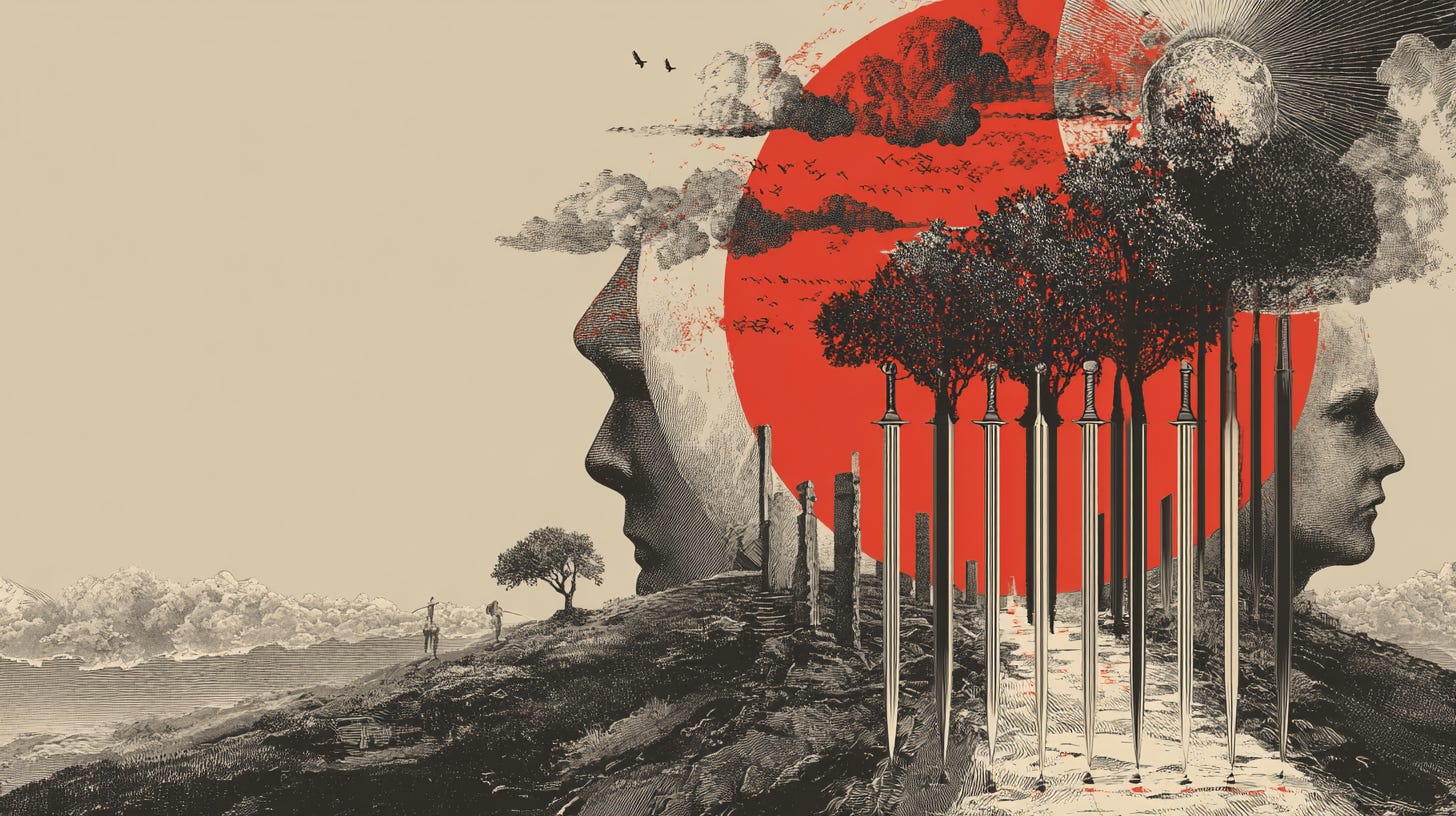
In today’s Tarot, I drew the Nine of Swords. The figure sitting up in bed, hands over face, blades mounted on the wall. Mental anguish. Desolation. How appropriate.
But the algorithm has already started its morning briefing. ICE in the headlines again. People marching in Minnesota. We are still processing the reports of ICE killing people - the word “processing” doing a lot of work there, as if grief were a queue. Governors are drawing lines, demanding federal agents leave their states. Members of Congress want Noem and Trump impeached.
In Silicon Valley, rich investors are paying $2,500 per embryo to beta-test genetic screening on their future children - debugging their bloodlines before the technology even works.
The feed presents all of this at the same scale. My cousin’s death. The state killing people. The wealthy engineering their offspring. Three inches of screen. No hierarchy of grief.
“When another person makes you suffer, it is because he suffers deeply within himself, and his suffering is spilling over. He does not need punishment; he needs help.”
— Thich Nhat Hanh
This is the new cognitive architecture. The algorithm doesn’t distinguish between personal loss and political crisis because it wasn’t designed to. It was designed to keep the inventory running. To keep us scrolling. To present the world as an endless series of urgencies, each one equivalent, each one demanding response, none of them allowing the kind of sustained attention that might actually lead to understanding - or to action.
The system wants us overwhelmed. Not ignorant - overwhelmed. Ignorance might lead to bliss, or at least to rest. But overwhelm leads to paralysis, and paralysis is a market segment. The attention economy doesn’t profit from your peace. It profits from your 6am inventory, from the mind that can’t stop running its accounts.
And yet.
I notice I’m not reaching for rage. Not toward ICE, not toward the colleague, not toward the tech bros optimizing their children. Rage would be another form of feeding the machine - the algorithm loves engagement, and outrage engages. What I’m reaching for instead is something quieter. A silent mourning. Clarity without heat. The capacity to name what is happening without letting it own me.
Some critics may say I should be fighting. Maybe they’re right. But I’ve learned to distrust the kind of fighting that leaves me depleted and the machine untouched. The feed wants my outrage. It has no idea what to do with my stillness. The right action comes from clarity, not reactivity. Sometimes that's marching. Sometimes that's stillness. Sometimes it's making the call you don't want to make, not to win, but to leave a door open.
The governors drawing lines against federal agents - that’s something. The people marching in Minnesota - that’s something. The workers who went on strike, who correctly diagnosed that ICE functions as labor discipline, not border security - that’s something too. The system wants me to see only the horror. But there are people refusing. There are people who looked at the machine and decided not to be its component parts.
My work colleague and I will talk at 5 pm today. I’ve been thinking about what I want to say.
Not accusation. Not defense. Something more like: I see what happened. I’m disappointed. I feel we lost trust in each other. But I’m not interested in arguing it out. I’m interested in whether we can find a different way forward. The algorithm teaches us to optimize for ourselves, to treat relationships as instruments. But I don’t have to accept that teaching. The betrayal happened. The karma is built. What happens next is still open.
This is, I think, what practice means. Not spiritual bypassing - I’m not pretending the hurt isn’t real. But I’m also not letting the hurt become the only thing. Somewhere between denial and drowning, there’s a place where you can feel the weight and still breathe.
My cousin is gone. I can’t call him back. But I can call the relatives who are still here, alone in their houses, wondering if anyone remembers them. That’s not a solution to anything systemic. It won’t stop ICE. It won’t regulate the genetic caste system being born in Silicon Valley. It’s just the thing I can do today, with these hands, in this life.
The algorithm will keep running its morning inventory. The feed will keep presenting catastrophe at scale. The swords will keep mounting.
But outside, the birds are playing in the snow. The Tibetan chants are older than the algorithm. Someone, somewhere, is driving hours to sit with someone who is alone.
If you keep waking up at 6 am with your own inventory running - you’re not alone.
Always remember: the ground still holds us.