The Mamdani Effect: Human Resistance in the Age of Digital Authoritarianism
How 50,000 volunteers toppled $40 million in super PAC money with zero Facebook ads—and what it means for the future of democracy in the age of algorithmic authoritarianism.

“True democracy is not about erasing the distinction between ‘us’ and ‘them’ but about constituting it in a way that turns mortal enemies into legitimate adversaries.”
— Chantal Mouffe
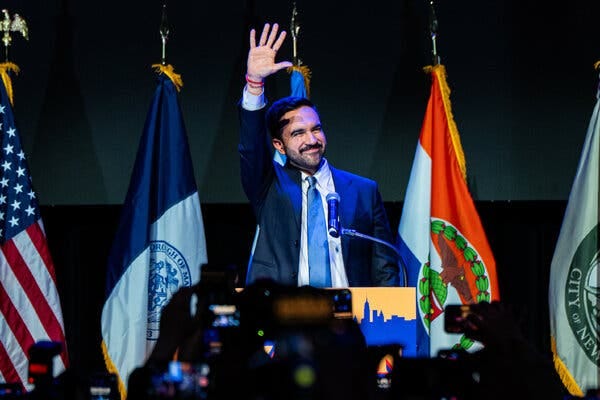
On November 4, 2025, in the capital of global finance, a 34-year-old democratic socialist became mayor.
The event itself was a glitch in the historical matrix, a rupture in the smooth, predictive surface of late-stage capitalism. But the truly scandalous detail, the part that sent a tremor of cognitive dissonance through the political consultant class, was not the what, but the how. Zohran Mamdani won not with a better algorithm, but with a human-powered anachronism.
A political machine, backed by a staggering sum exceeding $40 million in Anti-Mamdani PAC money that flooded every screen with warnings of chaos and decline, was toppled by over 50,000 volunteers (with numbers reportedly swelling toward 100,000 by the general election) who knocked on 1.6 million doors. The entire apparatus of modern campaigning—the micro-targeting, the sentiment analysis, the relentless air war of 30-second ads—was rendered obsolete by a technology it had forgotten existed: people talking to one another.
The system’s models went deaf to the analog signal rising from the streets. In a masterstroke of asymmetrical warfare, the campaign chose to become invisible, spending precisely zero dollars on Facebook ads while weaponizing social media as a broadcast, not a targeting mechanism. As such, it refuses to feed the very algorithmic beast that quantifies and neutralizes political desire. By starving the platforms of data, the movement vanished from the dashboards of the elite class, becoming a kind of political dark matter—unseen, unmeasurable, yet exerting an immense gravitational pull on the actual, physical city.
But how did Mamdani get here? What were his biggest inspirations? What failures did he face along the way? And how will Mamdani’s victory change the very nature of politics in the years to come?
“If we do not do the impossible, we shall be faced with the unthinkable”.
— Murray Bookchin
For Mamdani, the sudden victory of 2025 was preceded by the slow, grinding education of the late 2010s, an apprenticeship served not in the halls of power but in the trenches of failure.
It all started in 2015, when Mamdani volunteered for Ali Najmi’s City Council campaign in Queens. They lost. In 2017, now a member of the Democratic Socialists of America, or DSA, he managed Khader El-Yateem’s campaign—a Palestinian Lutheran minister running for city council in Bay Ridge. They lost. In 2018, he ran Ross Barkan’s bid for State Senate. They lost. Each campaign was a seminar in what doesn’t work: too much theory, not enough doors; too many endorsements, not enough organizers; too much faith in the progressive moment, not enough structure to sustain it when the moment passed.
But 2019 was different. 2019 was the year that taught him everything.
The Almost-Victory: Tiffany Cabán for Queens DA, 2019
Tiffany Cabán was a public defender running for Queens District Attorney on a platform of radical criminal justice reform: no cash bail, declassify sex work, prosecute landlords and wage thieves instead of the poor. It was an impossible campaign, a public defender challenging the machine in a borough where the DA’s office had been dynastic for decades. Mamdani signed on as field organizer. The DSA poured in volunteers. They knocked on doors in a way Queens had never seen—relentless, everywhere, in languages the borough actually spoke. They built the infrastructure: precinct captains, neighborhood leads, canvass after canvass, the same doors hit five, six times. They trained volunteers not just to persuade but to listen, to map the specific grievances of each block, to understand that criminal justice wasn’t an abstract issue but a lived experience—your cousin locked up on Rikers for a turnstile jump, your neighbor’s son who never came home.
And it worked. Almost.
On primary night, Cabán was up by 1,100 votes. The volunteers erupted in celebration. They had done it—a socialist public defender had just defeated the Queens machine. Then came the recount. The absentee ballots. The Board of Elections dragging its feet. The establishment candidate, Melinda Katz, fighting for every vote. When the dust settled weeks later, Cabán lost by 60 votes. Sixty. Out of over 90,000 cast.
The grief was real, but the lesson was sharper: They had nearly won. A broke, volunteer-powered, explicitly socialist campaign had come within 60 votes of taking over one of the largest prosecutor’s offices in the country. The model worked. It just needed to be bigger, tighter, more disciplined. Mamdani carried that lesson like a scar. Every conversation at a door mattered. Every volunteer trained was infrastructure. Every neighborhood mapped was territory held. You don’t win by inspiring people; you win by organizing them. The difference is structure.
The First Victory: Assembly District 36, June 2020
Ten months later, in the middle of a pandemic, Mamdani put the lesson into practice. He challenged Aravella Simotas, a five-term incumbent assemblymember representing Astoria and Long Island City. Simotas had the endorsements, the money, the institutional backing. Mamdani had a Google Doc full of names from the Cabán campaign and a hunch that COVID had shattered every rule about how politics was supposed to work.
The campaign was almost entirely volunteer-run—because it had to be. There was no money for paid staff. So they trained field leads, dozens of them, to run their own operations in their own neighborhoods. Each lead recruited their own team, managed their own turf, knocked their own doors. It was Bookchin’s confederation before they’d even read Bookchin: decentralized, horizontal, federated. The campaign wasn’t a hierarchy; it was a network of autonomous cells operating on shared principles.
And crucially, they didn’t just ask for votes. They asked people to join. Every door conversation ended with the question: “Will you volunteer?” Most said no. But enough said yes that the campaign grew exponentially, each new volunteer becoming a node that could recruit ten more. It was viral organizing, but the virus was human contact, not content.
It took nearly a month to call the race. Mamdani won by a margin so thin the Board of Elections had to count every absentee ballot twice. He was 28 years old. He had no institutional support. And he had just proven that the model could scale from a near-miss to an actual victory. The impossible was no longer theoretical.
The Hunger Strike: When Theory Becomes Flesh, 2021
But this education was not confined to the electoral map. It was forged in the physical discipline of direct action, most vividly in 2021 when Mamdani, now a state assemblyman, joined New York City’s taxi drivers for a 15-day hunger strike. This was not political theater performed for cameras; it was a desperate, bodily act of solidarity with a workforce of largely immigrant drivers crushed under predatory medallion debt. The city had sold taxi medallions—the licenses to operate a cab—for as much as $1 million each, telling drivers it was a safe investment, a path to middle-class security. Then Uber arrived, the value of the medallions collapsed, and the drivers were left holding loans they could never repay. Suicides followed. Families destroyed. The city shrugged.
Mamdani and the drivers set up camp outside City Hall. No food. Just water and the brutal arithmetic of desperation: How long can a body endure before the state blinks? Fifteen days. That’s how long. On day 15, the city buckled, agreeing to a deal that restructured the debt and secured $450 million in relief. The drivers had won not through legislation or litigation but through the willingness to put their bodies on the line, to make the state’s violence visible by absorbing it.
For Mamdani, it was a pure distillation of his political theory: Direct action, coalition-building, and relentless pressure could achieve what legislative niceties could not. The formal mechanisms of democracy—the hearings, the committee votes, the polite testimony—were theater. Real change came from making the contradiction unbearable, from forcing the state to choose between granting the demand or watching bodies collapse on its doorstep. The hunger strike was proof of concept for a different kind of politics, one that didn’t play by the rules because the rules were designed to make change impossible.
The Pandemic’s Gift: Mutual Aid as Pre-Revolutionary Infrastructure
Then came the dialectical switch: the spectacular failure of the state during COVID-19 provided the unexpected catalyst. As formal governance retreated—schools closed, services suspended, the wealthy fled to the Hamptons—an alternative infrastructure of care began to assemble itself in the void. Mutual aid networks, born from the urgent necessity of delivering groceries to the immunocompromised and elderly, became the living connective tissue of community. In Astoria, where Mamdani’s Assembly district was centered, the mutual aid network wasn’t just an emergency response; it became a school of solidarity, a daily practice of collective care that had nothing to do with the state and everything to do with neighbors learning they could rely on one another.
These networks—organizing food deliveries, covering rent for the laid-off, running tutoring sessions for kids stuck at home—were practicing a form of fugitive governance. They weren’t asking permission. They were simply doing what the state refused to do, and in doing so, they were building the relationships and infrastructure that no campaign could manufacture from scratch. Trust was being produced at scale, one grocery delivery at a time.
When Mamdani launched his mayoral campaign in October 2024, he didn’t need to build a base from scratch. He simply had to plug into this dense, pre-existing web of relationships. The mutual aid volunteers already knew how to organize a neighborhood. They already had lists of who needed help, who could give it, who was a natural leader. The campaign didn’t create the movement; it activated a movement that had been quietly assembling itself for years, waiting for a political expression that matched its values.
The Library of Scars
The campaign wasn’t built on a blueprint for success, but on a library of scars. The Najmi loss taught him to start earlier. The El-Yateem loss taught him that good candidates aren’t enough without infrastructure. The Barkan loss taught him that media buzz dies, but organizers persist. The Cabán near-miss taught him that structure is everything, that 60 votes is the difference between victory and oblivion, that every door matters. The 2020 Assembly race taught him the model could win. The hunger strike taught him that power respects only force. The mutual aid networks taught him that the revolution might already be happening, quietly, in the hallways and lobbies and stoops where neighbors were learning to take care of one another without waiting for the state’s permission.
By the time he announced for mayor, he wasn’t a long-shot candidate with a dream. He was a tactician with a decade of fieldwork, a proven model, and an army of people who had already learned to organize themselves. The victory wasn’t a miracle. It was a craft, learned in the trenches of loss and forged in the fire of collective struggle. The question was never whether the model could work. The question was whether it could scale from one Assembly district to an entire city.
November 4, 2025, answered that question.
“All forms of consensus are by necessity based on acts of exclusion”
— Chantal Mouffe
The enemy of my enemy is, it turns out, my business partner
The response of the established order was not merely one of opposition; it was a wholesale negation of the existing political logic, a frantic unification of contradictions against a common threat. The moment the primary was called for Mamdani, the old maps became useless. The shockwave of his victory dissolved the comforting fiction of a left-right political spectrum, revealing the raw, underlying structure of power.
The first sign was the former governor, Andrew Cuomo, who refused to concede the democratic contest. Instead of accepting defeat, Cuomo resurrected his campaign as an independent, a ghost haunting the general election on a “Prosperity & Safety” ballot line, a promise to deliver the city back to the sanity of elite rule. But the true rupture, the moment of terrifying clarity, came from an even more surreal corner.
In the campaign’s final hours, President Trump, threw his endorsement not to his own party’s candidate, the perennial gadfly Curtis Sliwa, but to the Democrat, Cuomo. In that single act, the entire ideological theater of the past decade collapsed into a singularity. It was a perfect, obscene demonstration that when faced with a genuine challenge to class power, the traditional antagonisms of the ruling elite are revealed for what they always were: a family quarrel.
And it worked: exit polls revealed 61% of Republicans abandoned their own candidate to back Cuomo, a perfect demonstration of class solidarity overriding party loyalty. This unholy alliance—the disgraced Democratic dynasty, the real estate and finance wings of both parties, and the nationalist right—was not a coalition. It was a popular front of the ruling class. The anti-Mamdani PACs swelled with cash, a war chest of over $40 million dedicated to a single, desperate objective: stop the socialist. The general election was no longer a contest between a Democrat, a Republican, and an independent. It was an agonistic struggle, in the purest sense of the term, between the insurgent city and the entire consolidated power of the American state and capital. When the insurgent is at the gates, the kings in their separate castles suddenly remember they are cousins.
Ironically, the campaign had successfully drawn a line so sharp and so clear that it forced everyone to choose a side, and in doing so, it revealed who had been on the same side all along.
Mamdani’s municipal socialism might become the last redoubt of the analog, the final place where human beings can practice politics as embodied, face-to-face, unmediated by screens and surveillance.
This brutal clarity of the battle lines was not a sign of democratic failure but of its radical success. The campaign represented a philosophical argument made flesh, a vindication of a whole intellectual tradition that the liberal consensus had declared dead and buried. The general election became a perfect, violent staging of Chantal Mouffe’s theory of agonistic democracy.
Agonism: Democracy as Conflict, Not Consensus
Chantal Mouffe is a Belgian political theorist and philosopher, known for her work on radical democracy, particularly the “agonistic” model, which argues that political conflict is inherent and healthy for a democracy. For Mouffe, the liberal dream of a rational consensus achieved through polite deliberation is a dangerous fiction that masks underlying power dynamics. True democracy is not about erasing the distinction between “us” and “them” but about constituting it in a way that turns mortal enemies into legitimate adversaries. The goal is not unity but a productive antagonism where opponents fight fiercely for their vision while recognizing the right of others to do the same. Democracy, properly understood, is not the resolution of conflict but its perpetual management.
Mamdani’s campaign did precisely this: it unapologetically constructed a “we”—the city’s multiracial working class of tenants, delivery workers, caregivers, and cab drivers—by defining a “they”—the landlords, the billionaires, the political dynasties who treated the city as a portfolio rather than a home. The unholy Cuomo-Trump alliance was the establishment’s panicked, reciprocal acknowledgment of this fact. It wasn’t a perversion of the democratic contest; it was the democratic contest revealing its true, irreconcilable, and beautifully conflictual nature.
But the sharpest edge of this agonistic politics cut through the question of Palestine. Mamdani’s vocal support for Palestinian rights and opposition to Israel’s war in Gaza became a wedge his opponents wielded mercilessly. Jewish voters broke heavily for Cuomo—60% to 31%—and the campaign’s final weeks were marked by accusations of antisemitism, death threats to Mamdani’s office, and demands for denunciation.
Mamdani refused the liberal script of both-sidesism but also refused to let the conflict collapse into enmity. He met with rabbis, attended synagogues during the High Holy Days, and pledged that under his leadership, City Hall would stand against antisemitism. This was agonistic pluralism in its most painful, unresolved form: not erasing the we/they distinction but insisting that adversaries could coexist in the same city, the same democracy, without one annihilating the other. The attempt was only partially successful—the wounds remain open, the tensions unresolved—but it was, perhaps, the only honest path available. Democracy does not require that we love one another, only that we refuse to kill one another. That fragile, perpetual negotiation is all that stands between politics and war.
Bookchin’s Confederation: The Field Leads as Autonomous Assemblies
This agonistic politics was built, quite literally, from the ground up, mirroring the forgotten theories of Murray Bookchin, an American social theorist, author, orator, historian, and political philosopher. Decades ago, Bookchin advocated for “libertarian municipalism,” envisioning a politics rooted in directly democratic neighborhood assemblies that would federate to form a counterpower to the centralized state. The assemblies would not be subordinate to a central authority but would coordinate horizontally, each maintaining its autonomy while acting in concert on shared principles. The model was participatory, ecological, and radically decentralized—citizenship as an active, daily practice rather than a passive status conferred by the state.
The Mamdani campaign, with its decentralized structure of hundreds of field leads operating as autonomous organizing hubs in their own communities, became a living, breathing model of Bookchin’s vision at scale. Each of the nearly 400 field leads was responsible for recruiting, training, and coordinating volunteers within their immediate geography—a few blocks, a housing project, a cluster of immigrant-dense streets. They were accountable not to a distant campaign headquarters but to their neighbors, the people whose doors they knocked on week after week. The leads operated with near-total autonomy: they decided which voters to prioritize, which issues resonated in their specific context, which volunteers showed leadership potential. The central campaign provided resources—walk lists, training sessions, political education—but the actual organizing was federated, horizontal, rooted in local knowledge that no consultant’s database could replicate.
This wasn’t hierarchy but confederation: the leads were captains of their own territories, coordinating with one another through regular assemblies where they shared tactics, troubleshot problems, and collectively strategized. If one neighborhood discovered that housing was the dominant concern, that intelligence spread through the network. If another found that free childcare was the winning message, the insight was adopted and adapted. The campaign became a city within the city, practicing a form of horizontal, face-to-face democracy that the official, top-down version had long since abandoned. Politics became a verb again, not a spectacle to watch but an activity to practice.
The Postcolonial Inheritance: Mahmood Mamdani’s Shadow
But there is another theorist whose presence haunts this campaign, one whose name Mamdani carries but whose influence is rarely acknowledged: his father, Mahmood Mamdani, the Columbia University political theorist and one of the most important postcolonial thinkers alive. The elder Mamdani’s magnum opus, Citizen and Subject, dissects the logic of colonial rule, particularly the British Empire’s system of “indirect rule” in Africa. The colonial state governed through a dual system: urban citizens subject to civil law and formal rights, rural subjects governed through “customary” law administered by co-opted tribal authorities. The result was a bifurcated state that ruled not through direct domination but through the strategic deployment of difference, creating political identities and then governing through them.
The son’s municipal politics can be read as an inversion of the father’s theory. Where colonial rule imposed centralized authority through local intermediaries stripped of genuine autonomy, Zohran’s campaign built genuine local autonomy that federated upward into a challenge to central power. Where indirect rule created ethnic and tribal categories to divide and conquer, the campaign built cross-ethnic, multiracial coalitions rooted in shared material conditions: tenant, worker, immigrant. Where the colonial state sought to destroy indigenous forms of self-governance and replace them with administratively useful proxies, the campaign resurrected and amplified neighborhood-level democratic practices—tenant meetings, mutual aid networks, community assemblies—that existed outside the state’s logic and threatened its control.
This is not a stretch. The candidate himself embodies the city’s postcolonial condition. Born in Kampala, Uganda, to Indian parents—his father a scholar of decolonization and his mother an award-winning filmmaker who has spent her career documenting the diaspora—Mamdani arrived in New York at the age of seven and became a naturalized citizen only in 2018. He speaks five languages with varying fluency: English, Hindi-Urdu, Bengali, Spanish, and Luganda. He references Bollywood in campaign videos and quotes Jawaharlal Nehru’s “Tryst with Destiny” speech in his victory address. The city is not a melting pot but a federation of diasporas, and Mamdani’s politics reflects this: not assimilation but confederation, not consensus but agonistic pluralism across irreducible difference. New York is not a nation-state in miniature; it is a postcolonial city, composed of populations who brought with them distinct languages, cuisines, and political traditions that cannot and should not be homogenized. The campaign federated these differences into a shared project while allowing each community to retain its autonomy and voice.
Wolin’s Fugitive Democracy: The Event That Refuses Permanence
But what kind of event was this? Here, we must turn to Sheldon Wolin, an American political theorist, writer, and Emeritus Professor of Politics at Princeton University, who described “fugitive democracy” not as a permanent state of affairs but as a rare, episodic eruption. For Wolin, democracy is what happens when the people, the demos, fleetingly appear and assert their collective power before the managed state of oligarchy inevitably reasserts control. True democracy is not a form of government—all governments tend toward oligarchy—but a moment of collective action that interrupts the normal functioning of the state. It is fugitive because it cannot be institutionalized without being destroyed; the very act of codifying democratic power into permanent structures transforms it into something else: bureaucracy, representation, administration. Democracy, in this sense, is always temporary, always excessive, always on the run.
The Mamdani victory was precisely that: a fugitive moment, a beautiful, temporary, and powerful flash of lightning that illuminated the entire landscape. It was the sudden, shocking appearance of the people as a coherent political actor—not as passive voters to be managed but as active subjects who organized themselves, articulated their own demands, and refused to be incorporated into the existing structures of power on terms other than their own. The 50,000-100,000 volunteers were not a political machine in the traditional sense; they were an eruption, a swarm, a temporary and overwhelming assertion of popular power that the state’s normal mechanisms of control—polling, media management, PAC money—could not contain.
The campaign, therefore, was not merely a campaign. It was a praxis, a living synthesis of agonistic struggle, municipal confederation, postcolonial resistance, and a fugitive assertion of popular sovereignty—a dormant political tradition roaring back to life on the streets of New York. But Wolin’s warning echoes: the fugitive moment cannot last. It is, by definition, unsustainable. The question is not whether it will end but what survives when it does. Can the structures built during the eruption—the tenant unions, the field lead networks, the mutual aid organizations—persist as forms of dual power even after the campaign’s energy dissipates? Or will they be absorbed, co-opted, neutralized by the very state apparatus they sought to transform?
That question remains unanswered. The inauguration has not yet happened. The fugitive is still running.
The Morning After
Wolin’s fugitive moment, that glorious eruption of democratic energy, now faces its own negation: the grinding, bureaucratic prose of governance. Vindicating a political theory in a campaign is one thing; implementing it against the consolidated power of the state and capital is another entirely.
The Fiscal Reckoning: When Math Meets Mandate
The platform of municipal socialism—rent freezes, free transit, universal childcare—was a brilliant tool for building a coalition, for drawing that sharp, agonistic line through the city. But the budget tells the brutal truth. Universal childcare: roughly $6 billion annually. Fare-free buses: $800 million per year. City-owned grocery stores: tens of millions in startup costs per borough. A rent freeze for the city’s one million rent-stabilized units: immediate legal challenges winding their way to a hostile Supreme Court, plus the economic warfare of real estate simply refusing to build anything new, manufacturing a housing crisis to prove the policy failed.
And here’s the cage: the mayor of New York controls almost none of this. Taxes can only be raised by the state legislature with the governor’s approval. Governor Kathy Hochul, eyeing her own 2026 re-election and terrified of losing suburban moderates, has already thrown cold water on Mamdani’s proposed 2% wealth tax on earners over $1 million. “We can’t drive people to Florida,” she warned—as if this were a threat rather than a promise, as if the rich departing wouldn’t free up housing and create space for the city to breathe.
The mayor of New York, for all his symbolic power, is in many ways a colonial administrator, dependent on the imperial capital in Albany for the resources to care for his subjects. His primary adversary is no longer a rival candidate but the structural logic of real estate capital, an industry that does not merely lobby the city but, in a deeper sense, owns it. A rent freeze is not a policy proposal to them; it is an existential threat to their entire model of accumulation. They will not deliberate; they will litigate, they will disinvest, they will deploy their immense power to ensure this experiment fails, and fails publicly, so that no other city dares to try.
The Transition: Smuggling Insurgents Into the Bureaucracy
But Mamdani’s opening move signals he understands the fight is systemic, not local. According to initial reports, his first major transition appointment sent shockwaves through the consultant class: Lina Khan, chair of the Federal Trade Commission and the most aggressive antitrust enforcer in a generation, named as Transition Co-Chair. Khan has spent her career dismantling the legal architecture that allowed Amazon, Google, and Meta to become ungovernable monopolies. Her presence in City Hall means Mamdani sees the enemy clearly: not just greedy landlords but the entire infrastructure of platform capitalism—the algorithmic landlords using AI to set rents, the private equity vultures buying up housing stock, the tech monopolies extracting wealth from every transaction while contributing nothing.
This is the dual power strategy made explicit: use City Hall to wage war on the systems that City Hall cannot formally control. Khan’s appointment suggests procurement battles ahead—the city spending billions annually on contracts, all of which can be weaponized. Want to sell software to NYC schools? Prove your algorithms aren’t biased. Want a city construction contract? Pay your workers a living wage and recognize their union. Want to operate in the five boroughs? Stop union-busting, stop illegal rent hikes, stop treating the city as your personal extraction zone.
The Opposition’s Playbook: How Power Defends Itself
The ruling class, however, has been playing this game for centuries and knows every move. Real estate won’t just lobby against the rent freeze; they’ll stop building entirely, claiming the policy makes new construction impossible. Within six months, there will be op-eds in the Times about the “housing crisis Mamdani created,” ignoring that the crisis predates him by decades. They’ll weaponize scarcity they themselves manufactured.
Wall Street will threaten capital flight, staging a slow-motion strike. “Business-friendly climate” will be invoked like a religious incantation. Bond ratings will be mysteriously downgraded. Pension funds will be warned that the city is “too risky.” The message will be clear: nice tax base you have there, shame if something happened to it.
The NYPD, promised reforms it has no intention of implementing, will engage in bureaucratic sabotage. Response times will mysteriously lengthen in progressive districts. Crime statistics will be selectively released to create a narrative of chaos. Rank-and-file cops will feed stories to the tabloids about the “anti-police mayor” who’s “putting New Yorkers at risk.” The goal isn’t to govern; it’s to make him fail, publicly and definitively.
And then there’s Trump. The president has already threatened to withhold federal funds—billions in transportation, education, and housing subsidies that NYC depends on. The threat is currently being litigated, but the legal process will take years. In the meantime, the uncertainty itself is the weapon. Every city agency will have to plan for two budgets: one if the money comes, one if it doesn’t. The chaos is the point.
But the sharpest knife might come from Albany, where the state legislature can simply refuse to act. Hochul won’t bring the wealth tax to a vote. The rent freeze will die in committee. Mamdani will be left with executive orders, municipal bonds, and creative interpretations of the city charter—governing through the cracks while the formal mechanisms of power remain locked.
The Dual Power Question: Can the Movement Survive the State?
And yet. The central, agonizing question remains: what becomes of the movement itself? How does a horizontal, federated network thousands of volunteers—the very engine of victory—survive its own success?
Here, the campaign’s structure offers a blueprint. The 400 field leads aren’t dissolving; they’re federating. Some are being hired into the administration, yes, embedding the organizing logic into City Hall itself. But most may remain outside, transforming into tenant union organizers, worker assembly coordinators, and neighborhood council leaders. For example, in Astoria, field leads can form a housing cooperative, buying a building collectively and removing it from the speculative market. In the Bronx, mutual aid coordinators can launch a time-banking system, allowing neighbors to trade skills and labor without money ever changing hands. In Brooklyn, organizers can work with a coalition of taxi drivers and delivery workers to create a platform cooperative—an app they own collectively, an Uber without the feudal overlord extracting rent from every ride.
This is dual power: not the state or the movement, but both, in constant tension and mutual reinforcement. The inside game and the outside game, coordinated but autonomous. When Mamdani proposes a policy and Albany blocks it, the movement escalates: rent strikes, mass actions, primary challenges to hostile state legislators. When the administration falters or compromises, the movement holds it accountable, reminding City Hall that the 50,000-100,000 people who put them in office are still organized, still capable of taking to the streets.
The risk, of course, is co-optation. Movements that succeed electorally often die administratively, their best organizers absorbed into the state apparatus, their energy redirected from disruption to management. The bureaucracy has a gravitational pull; it turns radicals into wonks, organizers into staffers, revolutionaries into regulators. This is how every progressive wave has been neutralized: not through repression but through incorporation.
The National Resonance: Mamdani as Proof of Concept
And the model is already replicating. On November 4, 2025, New York wasn’t the only city where democratic socialists won. Across the country, DSA-backed candidates claimed 11 victories: a city council seat in Austin, a school board in Seattle, a state house seat in Pennsylvania, municipal positions from Lansing to Richmond. Most went unnoticed by national media, but the organizers noticed. The spreadsheets were already being passed around: what worked in NYC, how to adapt it, how to build the field lead infrastructure in smaller cities where DSA chapters have dozens of active members instead of thousands.
The elite class, observing from their data dashboards, remains baffled. They see the victories but cannot reverse-engineer the process because the process is illegible to their instruments. You cannot A/B test a conversation. You cannot microtarget trust. You cannot algorithm your way into someone’s living room for a 30-minute discussion about what they actually need. The model works precisely because it refuses optimization, because it operates in the dimension of human relationship that capital has not yet fully colonized.
This is the deeper threat Mamdani represents: not just a socialist in City Hall but a vindication of a methodology that, if it spreads, could destabilize the entire logic of modern campaigning. If you don’t need consultants, pollsters, ad buyers, and data firms to win—if all you need is people and time and structure—then what exactly are the political parties for? What is the elite class selling? The empire, suddenly, has no clothes, and 50,000+ people in New York just pointed and laughed.
The Counterculture Question: Analog Resistance in the Age of Algorithmic Authoritarianism
Which raises the larger, more disturbing question: Is Mamdani-style socialism about to become the counterculture to elite Trumpian algorithmic domination?
Consider the emerging landscape. Trump’s second term is defined by the wholesale merger of state power and Silicon Valley’s most authoritarian tendencies: facial recognition deployed at the border and in blue cities, predictive policing algorithms determining who gets stopped and searched, social media platforms directly coordinating with federal law enforcement to suppress dissent, AI-driven surveillance making the panopticon look quaint. Elon Musk, the world’s richest man, functions as a shadow cabinet member, his companies holding billions in government contracts while his platforms shape political discourse with algorithmic precision. Peter Thiel’s Palantir provides the data infrastructure for ICE raids, military operations, and increasingly, domestic law enforcement. The libertarian dream of minimal government has inverted into its nightmare: maximal surveillance, minimal accountability, all power concentrated in the hands of a tech oligarchy that cannot be voted out.
Against this, Mamdani’s victory offers a radical alternative: governance through human relationships rather than algorithmic control. Politics as conversation, not data extraction. Democracy practiced in the hallways and on the stoops, invisible to the dashboards, illegible to the AIs. It’s a refusal of the premise that everything must be optimized, quantified, predicted, controlled.
This is why the establishment panicked. Not because Mamdani is a socialist—American capitalism has survived socialists before. But because his methodology threatens the entire infrastructure of control. If people can organize themselves into a political force powerful enough to take a city without feeding the algorithm, without enriching the elite, without playing by the rules of the game, then the game itself is revealed as optional. The emperor has no clothes, and worse, the empire has no moat.
In this sense, Mamdani’s municipal socialism might become the last redoubt of the analog, the final place where human beings can practice politics as embodied, face-to-face, unmediated by screens and surveillance. Not a reactionary retreat into nostalgia but a forward-looking resistance: using the old tools—door-to-door, conversations, trust built slowly over time—to build a future the algorithm cannot see coming.
And the lesson is always the same: democracy is not something you vote for once every four years. Democracy is something you practice, daily, in small ways, with your neighbors. It’s the conversation at the door. The tenant meeting. The mutual aid delivery. The cooperative formed. The assembly convened. Politics returning to its original form: not a distant spectacle performed by professionals but a craft practiced by amateurs who care enough to try.
PRIMARY SOURCES (Election & Campaign)
NBC News (Nov 4-5, 2025). “Zohran Mamdani wins NYC mayor election over Cuomo, NBC News projects.” Coverage of election results, volunteer numbers, Trump endorsement.
https://www.nbcnews.com/politics/elections/new-york-city-mayor-election-winner-2025-race-rcna238909CNN Politics (Nov 4, 2025). “Zohran Mamdani wins New York City mayoral election.” Campaign strategy, personal background, coalition building.
https://www.cnn.com/2025/11/04/politics/nyc-mayor-zohran-mamdani-winsNPR (Nov 5, 2025). “Zohran Mamdani wins NYC mayoral race.” Biographical details, Eugene Debs quote, voter turnout data.
https://www.npr.org/2025/11/04/nx-s1-5597788/election-results-zohran-mamdani-new-york-city-mayorCity & State NY (July 2025). “Here’s how Zohran Mamdani’s 50K-strong volunteer army pulled it off.” Interview with field director Tascha Van Auken, organizing methodology.
https://www.cityandstateny.com/personality/2025/07/heres-how-zohran-mamdanis-50k-strong-volunteer-army-pulled-it/406464/Jacobin (June 2025). “Zohran Mamdani’s Canvassing Operation Is What Democracy Looks Like.” Analysis of door-knocking infrastructure, 26,425 volunteers, 400 field leads.
https://jacobin.com/2025/06/zohran-mamdani-canvassing-nyc-mayor
BIOGRAPHICAL & BACKGROUND
Wikipedia (Updated Nov 2025). “Zohran Mamdani.” Comprehensive biography, political career timeline, personal life, legislative record.
https://en.wikipedia.org/wiki/Zohran_MamdaniPBS NewsHour (Nov 4, 2025). “How Zohran Mamdani rose from Queens lawmaker to mayor of New York.” Journey from housing counselor to mayor, 2021 hunger strike details.
https://www.pbs.org/newshour/politics/how-zohran-mamdani-rose-from-queens-lawmaker-to-mayor-of-new-yorkBritannica (July 2025). “Zohran Mamdani: New York City Mayoral Race, Democratic Socialism, Biography.” Education, family, policy platform.
https://www.britannica.com/biography/Zohran-MamdaniABC News (Nov 2, 2025). “In Uganda, where Zohran Mamdani was born, NYC mayoral hopeful is recalled with pride.” Early life in Kampala, father Mahmood Mamdani’s influence.
https://abcnews.go.com/International/wireStory/uganda-zohran-mamdani-born-nyc-mayoral-hopeful-recalled-127128135
ORGANIZING STRATEGY & ANALYSIS
Truthout (July 1, 2025). “Mamdani’s Ability to Break With Dem Status Quo Depends on Organizing From Below.” Grassroots nature, policy development through community collaboration.
https://truthout.org/articles/mamdanis-ability-to-break-with-dem-status-quo-depends-on-organizing-from-below/CADTM (Nov 5, 2025). “The Struggle Beyond the Ballot: Understanding Zohran Mamdani’s Campaign.” Analysis of grassroots organizing, coalition-building, municipal socialism.
https://www.cadtm.org/The-Struggle-Beyond-the-Ballot-Understanding-Zohran-Mamdani-s-CampaignArchyde (Nov 3, 2025). “Zohran Mamdani’s Historic Campaign: Mobilizing 100,000 Volunteers for New York City Mayor’s Race.” Volunteer recruitment strategies, retention methods.
https://www.archyde.com/zohran-mamdanis-historic-campaign-mobilizing-100000-volunteers-for-new-york-city-mayors-race/The Politic (Yale University, Oct 2025). “’He feels very close to us’: What We Can Learn from Zohran Mamdani about (Youth) Politics.” Youth voter mobilization, intergenerational organizing.
https://thepolitic.org/he-feels-very-close-to-us-what-we-can-learn-from-zohran-mamdani-about-youth-politics/
THEORETICAL FRAMEWORKS
Chantal Mouffe (2000). The Democratic Paradox. Verso Books. Foundational text on agonistic pluralism, radical democracy, friend/adversary distinction.
Murray Bookchin (1991). The Ecology of Freedom: The Emergence and Dissolution of Hierarchy. AK Press. Libertarian municipalism, social ecology, direct democracy.
Sheldon Wolin (2008). Democracy Incorporated: Managed Democracy and the Specter of Inverted Totalitarianism. Princeton University Press. Fugitive democracy, episodic popular power.
Mahmood Mamdani (1996). Citizen and Subject: Contemporary Africa and the Legacy of Late Colonialism. Princeton University Press. Indirect rule, postcolonial governance, bifurcated state.
MUNICIPAL SOCIALISM HISTORY
Shelton Stromquist (2023). Claiming the City: A Global History of Workers’ Fight for Municipal Socialism. Verso Books. Historical precedents, international comparisons, 1890s-1930s movement.
Dissent Magazine (Dec 20, 2023). “The World That Municipal Socialists Built.” Review essay on Stromquist, contemporary revival of municipal socialism.
https://www.dissentmagazine.org/article/the-world-that-municipal-socialists-built/
ADDITIONAL CONTEXT
Democratic Socialists of America (Nov 2025). “2025 Electoral Results.” National DSA victories, comparison to Mamdani campaign.
https://2025.electoral.dsausa.org/
I don’t really agree with all of what Mamdani has promisedto get elected. It seems like a pipe dream dressed up to get votes. And as you point out it may not even work or get caught in so much bureaucracy to be stymied for years.
After reading your analysis of his guerrilla tactics what I do appreciate is how he won. This seems like a counter culture style of vote earning that could have repercussions in other key battles.
The current style of democracy with PACs and money laundering needs to go. A boots to the ground, actually connecting with voters, system may be the thing that works to unseat the status quo.